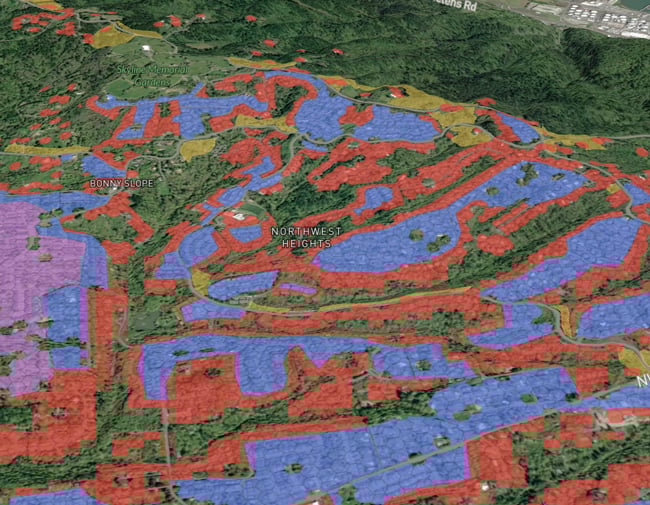
We offer the only fire intelligence platform purpose-built to model, measure, and operationalize mitigation for Fast Fires. But most fire models do.
Most models rely on static hazard indicators or isolate wildland and urban fire behavior. Our platform offers insights for the fast-moving fires that move between the two.
ACTIONABLE INSIGHTS
PREDICT
Forecast and visualize fire pathway risk
PRIORITIZE
Identify mitigations that matter and operationalize change
PROTECT
Engage the community and measure results
POWERED BY OUR TECHNOLOGY
FIRE PATHWAYS™ ARCHITECTURE
SIMULATION ENGINE
Models fire pathways and powers predictive visuals
RISK ENGINE
Turn fire science into actionable risk intelligence
Data, APIs, Integrations
BUILT FOR TODAY’S MOST THREATENING FIRES
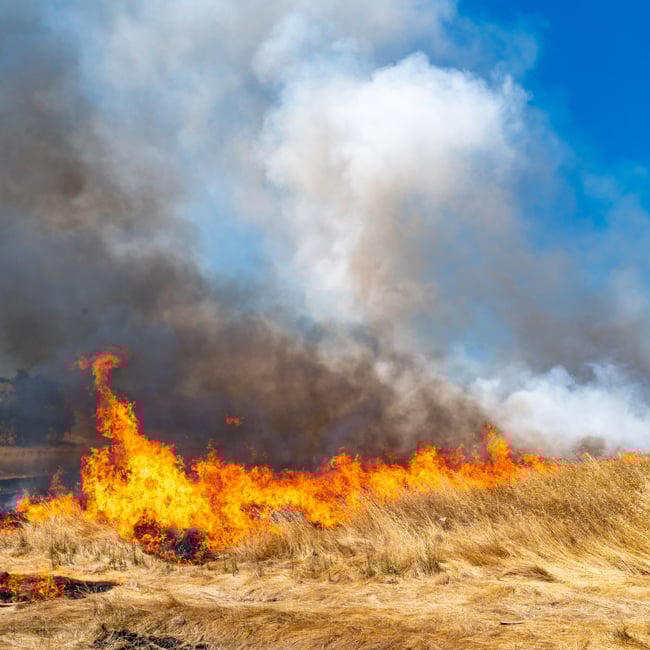
Fast Fires demand a fundamentally different approach to modeling. XyloPlan is the only platform that purpose-built to address this threat.
XyloPlan offers a holistic view of where communities are most vulnerable to Fast Fires. Our approach:
Simulates the full fire continuum: Vegetation → transition → single structure → urban conflagration.
Prioritizes speed and connectivity, not static hazard scores
Models the physics of structure-to-structure fire spread, not just forest fuels
Captures the real drivers of city-scale loss: wind alignment, ember transport, structure-to-structure ignition, and block-level spread.
Demystifies the transition zone between wildland and urban fire behavior
Operationalizes risk reduction across both wildland and built environments.
FIRE PATHWAYS™ ARCHITECTURE
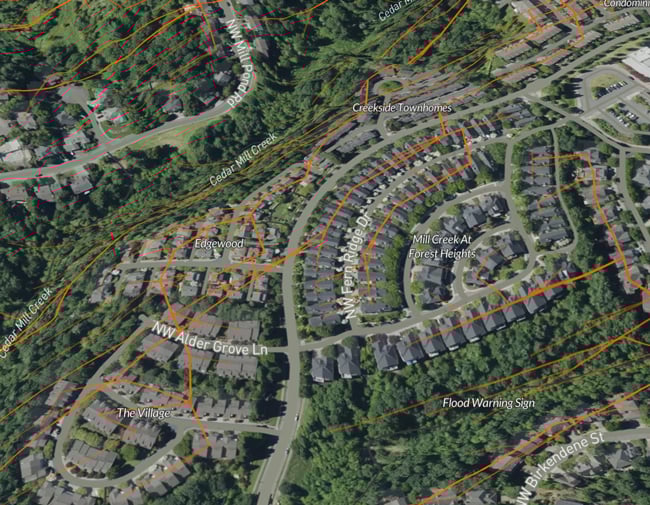
At the core of XyloPlan is our proprietary Fire Pathways™ Architecture — a system designed to model how fires move through communities and tell where mitigation can interrupt the advance of fire.
Most models rely on static hazard indicators or isolate wildland and urban fire behavior. Fire Pathways™ connects these domains, making it possible to identify where mitigation can meaningfully slow, disrupt, or stop catastrophic fire progression.
Connectivity
The chain of connective fuels — from vegetation to structures to entire communities — is largely invisible to legacy models, yet essential to understanding community-scale loss.
Relative Speed
Wind speed and alignment determine where catastrophic consequences are likely — and how quickly fire will reach community edges.
Vulnerabilities
Identifying weaknesses and areas of exposure in buildings, infrastructure, and urban environments.
Response & Evacuation
The relative relationship between fire arrival times, evacuation windows, and fire-suppression capacity.
ACTIONABLE INSIGHTS
Our Fire Pathways™ Architecture is powered by a Simulation Engine and a Risk Engine that work together to translate fire behavior into clear, actionable information.
XyloPlan’s proprietary engines give us our unique ability to provide fire intelligence for Fast Fires.
MODELING FIRE PATHWAYS AND POWERING PREDICTIVE VISUALS
Our Simulation Engine communicates the story about the threat of Fire Pathways™ with animated modeling of fire spread across wildland, transition, and urban environments.
KEY FEATURES
Dynamic animated fire spread visualizations
Animates fire spread across landscapes, showing pathway progression, speed, and potential impact.
Method of ignition
Breaks fire progression into methods of ignition, Surface Fire, Ember Threat, and Structure-to-Structure to help correctly match the mitigation to the method of ignition.
Scenario comparison visualizations
Enables side-by-side comparison of different mitigation strategies to evaluate outcomes.
Mitigation “what-if” visual playback
Replays the effect of planned mitigation actions (vegetation treatment, home hardening, defensible space) on fire progression.
Story-map–ready visual outputs
Exports visuals in formats suitable for community presentations and public engagement.
TURN FIRE SCIENCE INTO ACTIONABLE RISK INTELLIGENCE
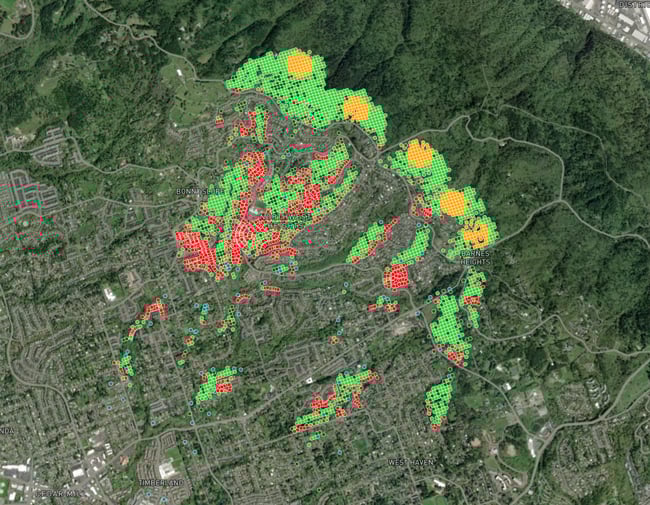
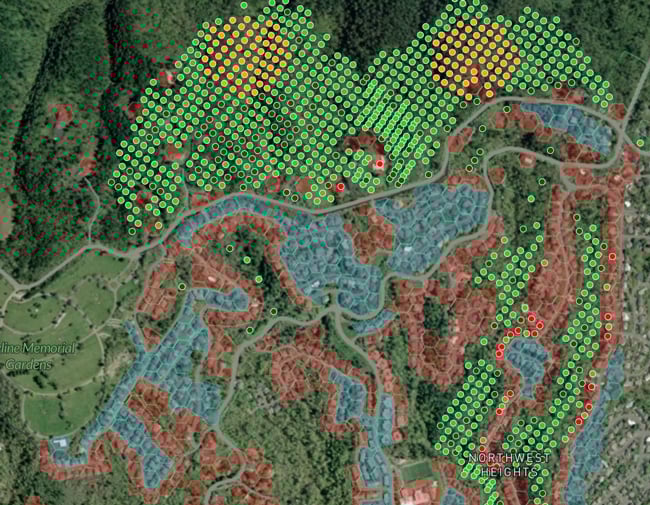
The Risk Engine translates fire behavior into defensible, operational insights. It calculates minimum travel times, structure-to-structure ignition probability, ember transport, and correlated-loss patterns, producing parcel-level risk scoring and mitigation prioritization.
By combining impact and achievability, the Risk Engine ensures that every mitigation action — whether home hardening, vegetation treatment, or creation of defensible space — can be evaluated for true ROI and tracked over time.
KEY FEATURES
ML-driven Fire Risk Modeling
Machine learning models estimate fire behavior, ignition probability, and exposure at the parcel level.
Minimum Travel Time fire spread modeling
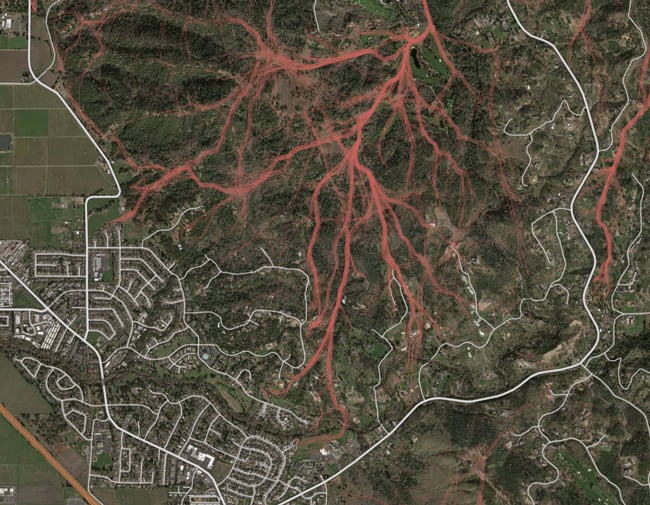
Computes the fastest likely path of fire across vegetative and urban landscapes based on fuels, slope, and wind.
Ember transport modeling
Models the spotting and transport of embers to predict ignitions ahead of the main fire front.
Conflagration Basin Analysis (correlated loss modeling)
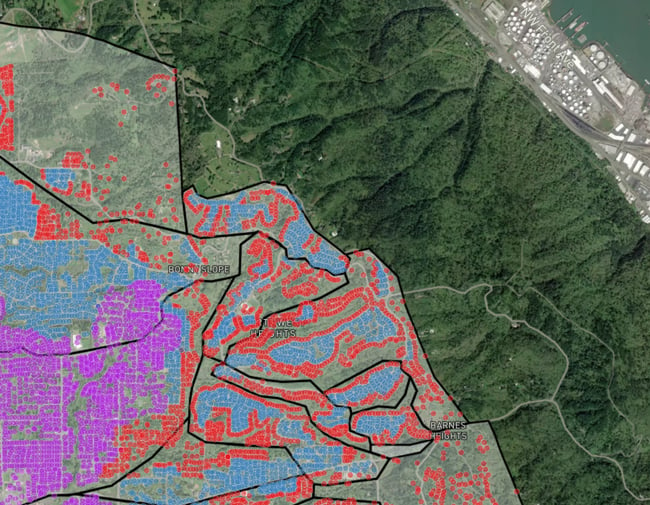
Identifies clusters of assets likely to experience simultaneous loss under worst-case scenarios.
Parcel-level risk scoring
Provides numeric risk scores for individual properties, combining structure, vegetation, and pathway exposure.
Probabilistic ignition likelihood
Quantifies probability of ignition for each parcel or structure based on combined factors.
Data ingestion + normalization across fuels and infrastructure
Consolidates data from traditional data sources (vegetation, weather, historical fires, regulations) and more dynamic data (home inspections, vegetation treatment), creating a unified dataset that accurately reflects the associated reduction in risk of loss to structures.
A COMMON PLAYBOOK
XyloPlan is the only platform that aligns insurers, fire agencies, and communities.
Everyone finally works from the same defensible, science-backed playbook.
We serve mitigation leaders (fire agencies, planners) and risk bearers (insurers and reinsurers) by bridging:
Fire science → operational mitigation plans
Mitigation Plans → insurer risk quantification
Community actions → measurable risk reduction
FIRE AGENCIES
Plan, justify, and operationalize mitigation at scale.